
Here's a moment most business owners don't think about until it's already happened.
A customer walks in, pulls out their wallet, and realises they left their stamp card at home. Again. They order anyway, say nothing, and walk out without a stamp. Three visits like that and the card feels pointless. Four visits and they stop looking for it altogether.
Nobody complains. Nobody says anything. The card just quietly stops working — and from where you're standing, everything looks fine.
That's the problem digital loyalty cards for business were built to solve. Not the big, visible problems. The quiet ones.
The Card in the Wallet Isn't the Same as the Card on the Phone
A paper stamp card does one thing: it records that a visit happened. No name attached. No pattern visible. No way to know if the person who stamped it last Tuesday has been back since.
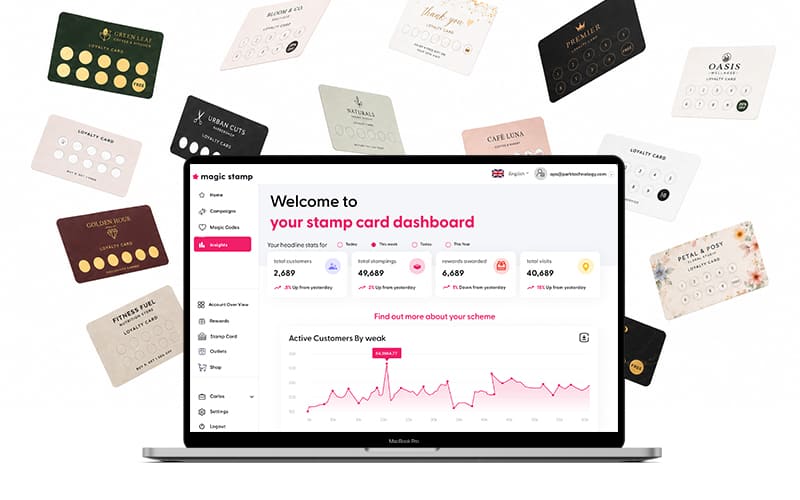
Digital loyalty cards for business do something different. Every tap is attributed. Every visit is logged. The customer isn't anonymous anymore — they're a person with a history, a pattern, and a relationship with your business that you can actually see.
That's not a small difference. It's the difference between running a loyalty programme and running one that works.
How the Digital Loyalty Card Works for Your Customer
This is the part most businesses overthink.
A customer walks in. They open the Magic Stamp app on their phone and hold it near the device at the counter. One tap. The stamp appears on their digital loyalty card instantly. They put their phone away and collect their order.
That's it. No QR code to line up. No app account to create before the first visit. No staff intervention required. The whole interaction takes less time than handing over a paper card — and unlike a paper card, it doesn't get left at home, lost in a bag, or forgotten at the bottom of a drawer.
For the customer, the experience feels effortless. For your business, that tap just updated their profile, logged the visit, and moved them one step closer to a reward they'll actually redeem.
The simplicity isn't accidental. It's what makes people do it again next time.
What a Digital Loyalty Cards for Business Actually Gives You
The customer experience changes less than you'd expect. They tap instead of stamp. The digital loyalty card lives on their phone instead of their wallet. The reward still builds, still feels earned.
What changes is everything underneath:
Visit frequency
You see who's coming in more often and who's starting to drift, before the drift becomes a decision.
Stamp progress
Who's close to a reward, who started collecting and quietly stopped, and where the drop-off tends to happen.
Lapse signals
Customers who haven't visited within a threshold you set get flagged automatically. Not at the end of the month. When it happens.
Redemption rates
The clearest indicator of whether your digital loyalty cards for business is actually working, or just generating cards that end up forgotten at the bottom of a bag.
None of that exists on a paper card. Not because paper is bad at loyalty — it isn't. It's just completely blind to everything that happens between visits.
The Moment That Makes the Commercial Case
Thirty days after a regular customer's last visit, most businesses still don't know they're gone.
With a digital loyalty cards for business, Magic Stamp flags it. The customer appears in your dashboard — name, visit history, last stamp date — and you still have a window to do something about it. One targeted offer. One reason to come back. Sent directly through the app, to the specific person who's drifted, at the exact moment it still matters.
That window is what digital loyalty cards for business actually sell. Not the card. Not the stamp. The window.
The Switch Is Easier Than the Inertia Suggests
The most common reason businesses stay on paper is that nothing looks broken. Customers use the card. Nobody complains. The programme technically runs.
But inertia has a cost that doesn't show up anywhere obvious. It shows up in the customers who stopped coming back months ago — whose names you never knew, whose absence you never noticed, whose value quietly walked out the door.
Magic Stamp replaces that with something visible. Setup takes no time. Customers don't need to download a separate app or create an account before their first visit. The first tap on their digital loyalty card is as simple as the first stamp ever was.
The difference is what it leaves behind.
Jefferson's London: What a Digital Loyalty Cards for Business Looks Like When It's Working
Jefferson's London is a coffee and ice cream shop built around the idea that everyday treats should feel like a small occasion. Their previous loyalty setup did what paper cards do — recorded visits, nothing more.
They switched to Magic Stamp because they wanted their digital loyalty cards for business to reflect the same care they put into everything else in the shop.

8,710
Customers actively engaged
57,684
Total visits logged
139,650
Stamps issued
12,497
Rewards awarded
Within a few months: 8,710 customers actively engaged, 57,684 total visits logged, 139,650 stamps issued, and 12,497 rewards awarded — all tracked, all visible, all actionable from a single dashboard.
The treats didn't change. The relationship behind them finally had a foundation.
The Question That Closes the Case
Jefferson's London didn't grow to 57,684 visits by hoping their regulars would stay. They built a system that told them — in real time — exactly who was coming back, how often, and when someone had gone quiet.
You don't need to change what you sell. You don't need to redesign the experience your customers already love.
You just need to be able to see it.
Ready to find out what your customer data looks like when it's visible?
Book a free demo or get started directly.